An Analysis of Blades in the Dark Criticism
Was the Dead Letters' podcast BitD episode dead on arrival?
The Dead Letters podcast recently did a careful, generous, and largely critical read of John Harper’s Blades in the Dark. Three experienced GMs, all designers and some proclaimed as gaming academics, sat down with the book cover-to-cover and came away frustrated. The setting was vibey but unrunnable. The mechanics didn’t do what they set out to and could be cheesed. The play loop was rigid in actual practice, even though the book claimed to be “fiction first”. They were honest about loving the game on first encounter yet finding it harder to love on close inspection, and they were honest about wondering whether they were just using it wrong.
I think they were looking at it wrong, but in ways the book itself invites despite its stated intent. The critiques they raise are common ones, and they recur across many discussions of Blades I’ve seen in the last seven years. They’re also worth taking seriously, both because the hosts are smart and because the recurrence suggests something is systematically going wrong in the transmission between John Harper’s design and a careful reader’s understanding of it. What follows is an attempt to untangle what is what.1
What Fiction First Actually Means
The foundational misreading runs through almost everything else, so it’s worth starting there. Sam sets up a binary between “endogenous rules” — the game’s mechanical apparatus — and “diegetic rules,” meaning the in-world physics of how things work. He then defines fiction first as “playing more by the diegetic rule set than by the endogenous rule set,” with mechanics emerging only when the diegesis triggers them. Under that definition, Blades is contradictory: it claims to be fiction first while making most of its mechanics nakedly metagame and explicitly allowing players to retcon the world via flashbacks and improvised contributions.
But that isn’t fiction first. It’s closer to simulationism, or to the FKR-adjacent idea that the world’s internal logic should constrain mechanical resolution. Fiction first concerns itself with the order of engagement, not the source of the rules. I like to call this the difference between a “fiction engine” and a “physics engine”. Blades is firmly in the former category.
Fiction engines are concerned with providing mechanics that resolve the fiction, versus trying to independently create a consistent reality. The conversation — the shared imaginative space — has primacy. A player describes what their character does (“I creep along the rooftop and listen at the chimney”), and only then do mechanics engage, if there’s a mechanic to do so. That’s the fiction first part in a nutshell. Crucially, fiction first mechanics don’t need to represent anything in the diegesis. The mechanics might or might not return a result that’s incorporated into the fiction. A fiction first game can have mechanics that don’t start from, interact with, or update the fiction; it’s simply that the game will lean very strongly toward those that do at least one of those things. Stress, position, effect, Devil’s Bargains, clocks are metagame tools that often interact with the fiction, serving the conversation by giving the players a shared vocabulary for stakes and consequences. Whether they “exist” inside Duskvol or not is irrelevant; they exist at the table, where the fiction is actually being made.
This is where part of the critique of Blades’ rules goes sideways. Misha correctly notices that the ritual conversation isn’t about Duskvol sorcerers negotiating with the cosmos — it’s the GM and player figuring out what a ritual does at the table. He calls this “fiction second,” but it’s actually pretty cleanly fiction first: the negotiation is happening in fictional terms (what does this ritual do, what does it cost, what could go wrong) and mechanics come in only to resolve uncertainty afterward. That the negotiation doesn’t simulate an in-world process doesn’t disqualify it as fiction first; the principle isn’t “fiction always” or “fiction last”. Fiction first only means that the conversation starts from the fiction; the mechanics don’t have to simulate in-world processes.
As a result, the “potential vs. established fiction” distinction the hosts find contradictory is, in fact, kind of a nothing sandwich. What’s real is what’s been established in the conversation. What hasn’t been said yet is just potential and has no bearing on whether you’re playing fiction first; it’s just a possibility constrained by the shared understanding of the fiction. Flashbacks let players retroactively add to that established fiction at a stress cost, but they can’t contradict anything that’s been nailed down. This isn’t a betrayal of fiction first; it’s the principle taken seriously. The fiction lives in what the group has actually described to each other, not in a GM’s prep document that nobody else can see.
Where the hosts do seem to have a real preference — and it’s a coherent one — isn’t about fiction first at all. They seem to want pre-established, deeply detailed worlds with consistent in-world logic that constrains play. They want, as Sam puts it later, to be Sherlock Holmes rather than to write a Sherlock Holmes mystery. That’s a valid preference — roughly OSR/simulation — but it’s a different axis from fiction first vs. mechanics first. Blades is genuinely fiction first; it just happens to be collaborative-emergent rather than pre-simulated. By collapsing those two dimensions into one, the hosts make Blades look self-contradictory when it’s actually doing something they happen not to want.
The Duskvol Question
The same conflation drives the critique of the setting. Sam’s frustration with the Crows’ entry — “claims all of Crow’s Foot as their turf, every district pays up to them, HQ in the abandoned city watch tower, operates gambling, dancing in Crow’s Foot, and extortion rackets at the docks” — is that it’s “an idea, a suggestion, a notion.” But for Blades, that’s the deliverable, not a shortfall. The book hands the GM a seed with enough specificity to anchor the table’s imagination (a name, a turf, a vibe, a few hooks) and explicitly leaves the rest as the GM’s creative territory.
This isn’t an oversight. Blades has no traditional encounter design. There are no stat blocks to balance, no dungeon keys to write, no monster manuals to consult, no CR math, no treasure tables to roll on. Strip those away and ask what’s left for a GM to actually do in prep, and the answer is: develop the city, develop the factions, decide where the Lampblacks’ fence operates, and determine which canal the Bluecoats patrol on Tuesday nights…when it becomes important. That authorship is the GM’s wheelhouse. The vagueness the hosts identify as a bug is the negative space that gives the GM something to make. A book that pre-specified the location of every gang’s safehouse, the names of every lieutenant, and the routine of every patrol would make every table’s Duskvol identical, which is the opposite of what Blades wants.
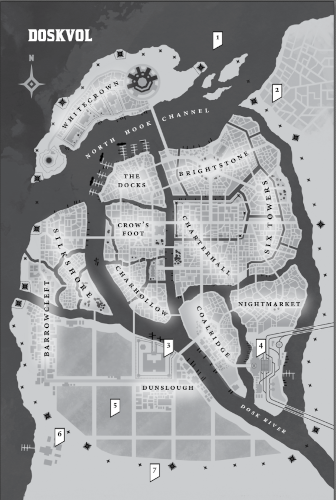
Mewanwhile, Walid says he’s “wildly surprised” the book ships without an interior map, which isn’t true — there’s a one-page city map plus a two-page spread for each district with a close-up map, named landmarks, and atmospheric notes. What it doesn’t have is the level of detail Walid wants: street-by-street fidelity, with every gang’s exact safehouse marked, building floorplans, and Bluecoat patrol routes. The cartography in the book is doing exactly what the faction writeups are doing: providing seeds with enough specificity to anchor improvisation and enough negative space to require it. A reader who wants Tim Denee-level detail (whose maps are amazing, I’ve used them myself) will find the spreads insufficient; a reader who understands that the intent of Duskvol is for it to become their own will find them about right.
Sam frames the broader version of this as a problem when he observes that Duskvol “doesn’t feel the same from table to table” and that “we’re using the same proper nouns” while everything else varies. He treats this as evidence that the book has failed to communicate its setting. But variance between tables isn’t evidence of communicative failure. The relevant test isn’t “do all tables produce the same Red Sashes” but “do the Red Sashes at every table feel recognizably like Red Sashes.” The proper-noun convergence the hosts notice is a feature, and not a bug. Compare this to the Strahd example Sam reaches for: Ismark is apparently iconic (I don’t know, I know nothing about it) precisely because Curse of Strahd is a pre-authored adventure, a fixed text designed to be experienced. That isn’t what Duskvol is supposed to be.
The “vibes vs. substance” framing inherits the same expectation. Walid’s frustration is that the lore is “vibes” — atmospheric, evocative, but not gameable in the sense of telling you what to do at the table. But for a fiction-first game with no encounter calculus, vibes are substance. The job of the setting write-up is to give the GM and players a strong, coherent aesthetic and tonal foundation so that improvisation at the table stays inside a recognizable world. “Lord Scurlock the Vampire” and “the Red Sashes vs. the Crows” aren’t placeholders for missing detail; they’re prompts waiting to be completed. A GM with that prompt can generate hours of consistent, on-tone play. A GM with a fully detailed Scurlock dossier — exact age, manor floorplan, daily schedule — has been handed someone else’s character to manage.2
It’s worth flagging that a real piece of the game’s structure goes unmentioned in the critique: the tier and hold system for factions. Tier represents crew and faction power and reach; hold represents how secure that tier is. This system does much of the work that the hosts complain is missing. It tells you whether the Crows can crush your six-person Bravos crew (yes, they’re Tier III, you’re Tier 0) and what shifts when your scores damage them (their hold drops, they become vulnerable to other factions). It’s not as detailed as a stat block, but it’s mechanical knobs and levers for faction interaction that the podcast conversation treats as missing. The “where are these factions, how do they interact with my crew” question is answered in the book through status, rep, and tier rather than through predefined, proscriptive write-ups.
The Dead Letters hosts frame GM authorship as overhead that the book ought to have eliminated. “It takes so much effort from the GM to create this authentic Duskvol that the book simply doesn’t provide for you.” But authorship isn’t overhead in this game; it is the game from the GM’s seat. A trad GM creates encounters and stat blocks; a Blades GM makes faction moves and determines how that affects the city and the crew. When the hosts say there’s “not enough here to run,” they’re noticing that Blades doesn’t supply the kind of prep deliverables they’re used to consuming, and concluding the setting is incomplete, rather than that the prep itself has changed shape.
Misha briefly catches this — “are we just using these wrong?” — and worries the three of them are professional designers who undervalue ideas because they have so many of their own. That worry lands closer to the truth than the conversation lets it sit. The book is pitched at a GM who wants to author a city; the hosts want to inhabit one that’s already been authored. Both are valid. But routing the latter’s disappointment through a critique of the book’s “incompleteness” mistakes John Harper’s deliberate decision for a failure of execution.
The Backflip and the Clock
The mechanical critique suffers from similar issues. Misha offers a thought experiment meant to expose a flaw in the system: a player has a seven-tick clock (okay, eight, though to be clear, nothing in the book prohibits a seven-tick clock) that’s almost full, declares “I do a backflip,” picks Prowl, rolls a 6, and claims a tick on the clock. They’ve overcome the obstacle by gaming the system! The implication is that the rules let players cheese clocks by declaring arbitrary actions, and the GM is stuck rubber-stamping it because position and effect are the only dials available to them.
But position and effect aren’t the GM’s only dials, and “limited effect” isn’t the floor. The floor is no effect, and the basement is no roll. Before any dice touch the table, the GM and player negotiate the action declaration in the fiction: what is the character actually trying to do, and is it a thing that could plausibly affect the situation as currently described? If a player declares an action whose connection to the obstacle is purely notional — a backflip with no fictional pathway to advancing the clock — the correct response is not “okay, limited effect, roll Prowl.” It’s “What does the backflip do? What in the fiction does it change?” If the answer is “nothing”, no roll occurs. The clock doesn’t tick. The player hasn’t engaged with the obstacle; they’ve performed in the empty space next to it.
It’s worth being precise about player authority over action ratings here, because this is where the example slips up. Blades does say the player chooses the action rating they’re rolling — they decide whether the fictional thing they’re doing is best resolved with Prowl, Finesse, Skirmish, Sway, or whatever else fits. That’s a deliberate piece of player authority; it lets the player frame their character’s approach to a problem rather than having the GM dictate “no, that’s a Wreck roll.” But choosing the action rating is choosing the method of resolution, not declaring the effect on the situation. The effect is set by the GM based on the fiction: the character’s position, the quality of their tools, any potency they might have, and the nature of the obstacle. A player can say, “I’m doing this with Prowl”; they cannot follow that with, “and therefore this ticks the vault clock.” The first is a player-side call about what action their character performs. The second is a GM-side call about how the roll affects the established situation, and it’s grounded entirely in whether the fictional action engages with the fictional obstacle.3
Collapsing those two — treating the player’s choice of action rating as automatic permission to affect any clock on the table — is what makes the backflip look like a loophole. It isn’t one. The player picks Prowl; the GM still gets to say the backflip has no bearing on cracking the vault, so there’s no roll, or else the roll needs to resolve something else (looking cool, not falling, catching the eye of a guard) that doesn’t touch the vault clock at all. Player authority over the chosen action is real. It’s just not what the conjectural example needs it to be. It’s very similar to a mutual of mine saying they once read a post where someone claimed they could do something outrageous, like grabbing the sun in Apocalypse World, if they rolled a 7+, because the rules didn’t say they couldn’t.
In the end, this is fiction first operating exactly as advertised. Mechanics are downstream of the fiction. An action roll is what you reach for when a fictional action has uncertain outcomes worth resolving — not a slot machine you feed by naming an action and rolling dice. The GM’s job isn’t to find a way that honors the roll no matter what, it’s to honestly and critically set position and effect and set the consequences. The book very clearly spells this out and gives examples of how various situations could play out. The trope of “I roll Persuasion, I got a 20, they have to do what I want” doesn’t apply (to be honest, it almost never applies).
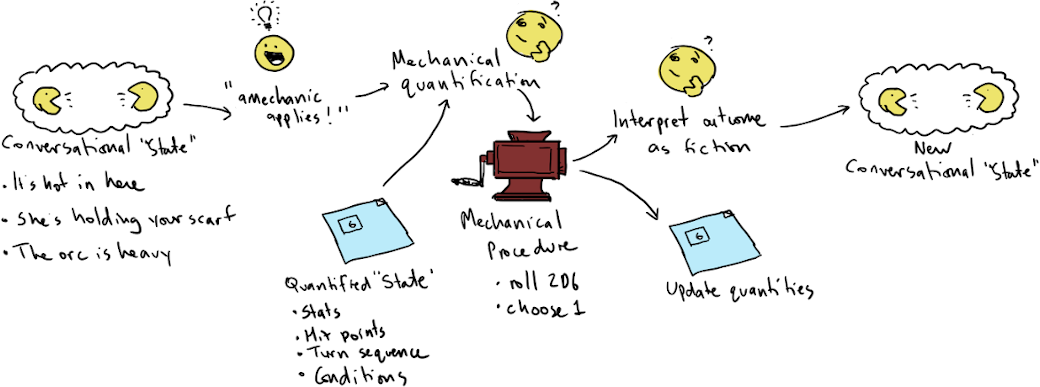
The same logic resolves the clock misreading example. Misha treats the clock as a hit-point bar that any successful roll chips at — the rules’ job is to determine how much. But a clock represents progress on a specific fictional process: cracking the vault, evading pursuit, building the bomb. Ticks come from actions that advance that process in fiction. The backflip doesn’t advance vault-cracking, so it can’t tick the vault clock, regardless of what the dice say. If the player wants to tick the vault clock, they have to do something that, in the fiction, moves vault-cracking forward. The clock isn’t an abstract progress meter divorced from the fiction; it’s a representation of fictional change, and only fictional change fills it.
This is also why Sam’s memory of a “mission tier to required clock count” chart (it was likely a recollection of the guidance that scores should have three obstacles, which in itself is a suggestion and not a requirement) would have been a poor fit. Clocks aren’t merely difficulty units; they’re representations of specific fictional processes. A four-tick clock on the players’ side represents a relatively easy win; opposing them, it’s a fast-moving consequence. A chart of how many clocks a particular “tier” score requires would replace fictional reasoning with mechanical lookup. That said, this is one of the genuine places where solid guidance would help newer GMs find their footing — other than the suggestion that scores have three obstacles, it’s a real gap in the book regarding clock sizes, even if a strict difficulty chart would be the wrong fix.
A couple of other mechanical complaints are similar. Sam dismisses Devil’s Bargains because “we’ve just been five minutes arguing about what they should get you,” framing the negotiation as overhead. But Devil’s Bargains aren’t about “what you get” — they’re a tool for compressing things the table doesn’t want to zoom in on, in exchange for a cost. You state the Devil’s Bargain, the player agrees, and it happens. Deep Cuts refines this framing explicitly: a Hound taking down an inconsequential guard isn’t a scene worth resolving with an action roll, so the GM offers a Devil’s Bargain (take a few stress, the guard is down), the stress is paid, and the group moves on to what they actually care about. Five minutes of arguing over what the bargain should get you means the table has misunderstood the mechanic’s purpose.
When you remove these misreadings, the backflip exploit dissolves, and a different picture of Blades emerges — one where the GM has substantial authority to adjudicate what counts as engaging with the fiction, and where the system actively rewards players for thinking in fictional terms rather than mechanical ones. The hosts’ complaint that “the rules become more real than the story” describes a table playing Blades as if it were a board game with flavor text. That’s a real failure mode and, unfortunately, a frequent one. It neglects that the number one rule is “follow the fiction”, regardless of rolling a critical with Prowl when Prowl won’t address the obstacle.4
The Crew, Not the Caper
Sam’s strongest single objection is that Blades skips the planning phase that defines heist fiction. Ocean’s Eleven and The Sting are largely setup and planning; Blades says to skip the shopping trip and planning in exchange for the load system, engagement roll, and flashbacks. He treats this as Blades trying and failing to emulate heist cinema, and as confirmation that the game has gutted the part he most wants to play.
But Blades isn’t trying to give the experience of watching a heist movie — it’s trying to provide the experience of being a competent criminal crew. The flashback mechanic represents off-screen competence: you don’t show the planning because your characters are professionals who have already done it, and flashbacks are how that prior preparation surfaces when it matters. The crew planned, you’re just doing the action rolls to find out how that went after the fact. In Blades, when the action roll occurred doesn’t matter…there’s a good argument that the whole game, from action rolls to load to resistance rolls, is just flashbacks all the way down. This is closer to how Leverage handles its “I had a plan for this” beats than to how Ocean’s Eleven handles its long con (and, for the record, John Harper is a fan of the Leverage RPG; he even designed a custom character sheet for it). Both are valid heist paradigms; it’s just that the hosts want one and Blades delivers the other. The complaint that Blades skips planning misreads the intent.5
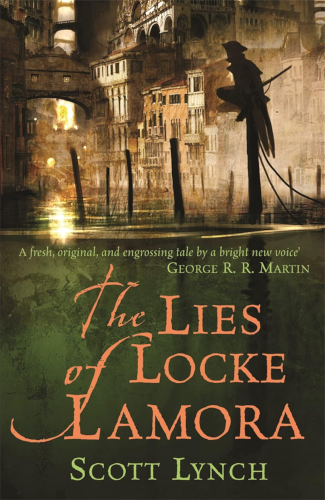
This also clarifies what Blades is actually for, which is where the conversation’s choice of references becomes telling. The hosts cycle through Peaky Blinders, Ocean’s Eleven, The Sting, Money Heist, and Gangs of New York as touchstones, with a single passing mention of Dishonored. What’s striking is that the other works that Blades takes inspiration from aren’t discussed. Thief: The Dark Project — Looking Glass Studios’ 1998 “first-person sneaker”, set in an industrial gothic city with rooftop infiltration, religious orders, pagan undercurrents, and a master thief working the spaces between factions — is as much a visual and atmospheric inspiration for the game as Dishonored. Dishonored, mentioned only in passing, is so directly a touchstone that “Duskvol” is a near-homophone for Dunwall and “leviathan blood” maps directly onto whale oil. Bluecoats even map neatly to the city watch. Scott Lynch’s The Lies of Locke Lamora and the broader Gentleman Bastards novels provide the structural template: a small crew of professional criminals in a fantastical city, pulling off elaborate scores, navigating a thick web of rival gangs and aristocratic factions, with supernatural complications threading through the whole thing. There’s even some shared vocabulary, such as crews and scores, and a parallel to The Spider playbook with Doña Vorchenza — Camorr’s secret police spymaster, called “the Spider”. When I was reading The Lies of Locke Lamora, every few pages I was saying to myself, “This is Blades in the Dark!” What’s striking about The Gentleman Bastards is that there also isn’t detailed planning for scores; we see some of it, but that’s not the focus of the books.
These three touchstones are remarkably consistent with Blades’ tone and focus: industrial gothic, supernatural intrusion into a working-class criminal milieu, crews running operations in a city that is itself a character. That’s the tonal range Blades is aiming at, and it’s narrow on purpose. Peaky Blinders shares some surface vibes but is fundamentally a family melodrama with violence; Ocean’s Eleven is a slick contemporary heist movie with a caper vibe. When the hosts complain that Blades doesn’t deliver these experiences, part of what’s happening is they’re asking the book to be five different heist properties at once, even though its actual influences point in one consistent direction. Blades does Lies of Locke Lamora-the-RPG very well. The more heist-focused touchstones require adjustments to Blades’ feel and tone (albeit not big shifts). The structural elements the hosts find frustrating (the truncated planning, the flashbacks, the focus on the crew over the caper) are exactly the elements that fit the significant touchstones: Garrett doesn’t show his planning, and the Gentleman Bastards operate as a crew.
Sam invokes Sean McCoy’s “I don’t want to write a Sherlock Holmes mystery, I want to be Sherlock Holmes” as an articulation of a real divide, and uses it to position Blades on the “writing” side and trad games on the “being” side. That’s not quite right. Blades is genuinely on the “being” side for action — when you’re in a score, you are a scoundrel doing scoundrel things, and the action roll framework is meant to feel inhabited rather than authorial. Where Blades shifts toward “writing” is in the scaffolding around the score: the engagement roll abstracts the approach, flashbacks let you author past competence, and the crew sheet lets you author your operation. This isn’t writing-vs-being; it’s a hybrid where you inhabit the moments that matter and let the connective tissue do the rest. Treating it as fully on the “writing” side misses what it’s doing in the actual score, which is some of the most “being” play in modern RPGs — particularly when the game is leaning into its actual influences rather than being asked to reproduce Ocean’s Eleven.
Why the Misreadings Happened
So far, this has read as a defense of Blades against careless critics. But the hosts aren’t reading it carelessly. They’re reading it carefully, and they’re still landing in the same place that a lot of both casual and careful readers land. That recurrence deserves explanation, and the explanation isn’t flattering to the book. Blades is genuinely hard to extract the right play model from a cover-to-cover read. This arises from three presentational problems: the rules are organized in a way that muddies their fiction-first intent, the rules text itself comes across as highly procedural, and the play loop is presented as a fixed sequence.6
Let’s start with the organization. The first 160 pages — which all three hosts agree are very strong — front-loads mechanical apparatus: action ratings, position and effect, stress, trauma, harm, resistance, Devil’s Bargains, flashbacks, playbooks, downtime, load. It’s easy to see this as the real meat and potatoes of the game. It’s a very common way to organize TTRPGs, and for good reason, since often players and GMs need that baseline to understand later material. It’s just in Blades’ case, the mechanics in play are nested within the player and GM principles (which comprise the following 55 pages). A reader with trad instincts opens the book, sees a mechanical chassis up front, and naturally reads the later chapters as flavor commentary. When seeing the chapter titled “Running the Game”, the seasoned GM says, “I don’t need to know how to run a game, I already know how!”, ignoring that they’ve never run this game, and missing that the chapter on doing so is just as integral as the 160 pages of mechanics. The hosts do exactly this. Misha’s careful description of position and effect as “a really nice tech for making conversation and adjudication run more smoothly” gets immediately followed by his frustration that the game “doesn’t actually go that far” — because the book presented those tools up front, not as the follow-through of the fiction-first loop.
The rules text problems compound this. Blades reads procedurally. Sections like the downtime rules or the ritual rules (which Walid singles out as tedious) are written as step-by-step processes: have this conversation, then follow these steps from 1 to x. The book describes a procedure without highlighting the overarching fiction first framing, and that trains the reader to execute without keeping with “follow the fiction” principles. Walid’s “you sit there and go back and forth to try and find a framework that fits both of these systems at the same time” is the natural result. The principle being illustrated — that ritual creation is an open conversation that mechanics resolve when uncertainty arises — gets flattened into “do step one, then step two.” If the book had said “rituals don’t have fixed rules; here’s an example of how a table might negotiate one” and then walked through a sample rather than enumerated stages, the same content would land as guidance instead of as a checklist that frustrates people who run it because it doesn’t align with the fiction.
The play loop is the clearest case of presentation resulting in a skewed mental model. Blades describes free play, the engagement roll, the score, payoff, heat, downtime (with its own subdivided activities), and back to free play, in that order, presented as a set loop to always follow. A reader encountering this — especially one first encountering this type of play loop — reasonably concludes that this is the sequence, and that running Blades means moving the table through these phases like an assembly line. The hosts’ confusion about scores per session reflects a literal interpretation of the free play > score > downtime loop, which needs to neatly fit within a session. It ignores that “follow the fiction” is the number one rule.7
The fiction-first reading of the play loop is that these phases are reflective of the intended fiction’s natural rhythm, not stations the table must visit in order. Free play and downtime can collapse into each other when nothing structural separates them — if the crew is recovering, scheming, socializing, indulging vice, and taking care of other business in the same evening of game-time, the GM doesn’t need to formally close downtime and open free play. The engagement roll can be skipped when the fictional setup has already established how the score begins; rolling engagement when the players have spent twenty minutes playing through slipping into the warehouse that they just discovered is the kind of mechanical busywork that the principle of fiction first would tell you to skip. If it looks like the PCs have wandered into a very score-shaped situation, it must be a score. Multiple scores in a session become possible — even natural — when the GM treats the score as “the focused, high-stakes part of the fiction” rather than as a self-contained module with mandatory framing and resolution phases. In this light, John Harper’s claim that he runs multiple scores in a session seems much more achievable.
But the book never quite says any of this. It presents the play loop and other processes in a way that gives the impression that the game should follow them without variation, largely, I believe, to make sure that the focused structure is internalized by players who may not have encountered this style of gameplay. John Harper was right to communicate it clearly, since in many cases the loops do work well, and in a hobby dominated by D&D’s playstyles and expectations, it makes sense to come on very strong regarding the differences. But “come on strong” tipped over into rigidity, and the result is that GMs internalize the structure as “the way it always has to be” instead of a flexible framework. The book needed it to be said much more prominently: these phases are descriptions of the rhythm play tends to settle into, not stages you must move the table through. When the fiction wants to compress them, compress them. When the fiction wants to skip one, skip it. The loop is a model of what often happens, not a script for what must be done next. The absence of that strong guidance shows up across actual plays and posts about the game, where they are trying to shoehorn what’s happening in their fiction into a rigid framework.8
What This All Adds Up To
The misreadings within the podcast are definitely real. The backflip example is still a category error; the setting critique still mistakes authorial space for missing content; the planning-skipping complaint still misidentifies the focus and touchstones; the fiction-first complaint still confuses procedural order with mechanical sourcing (and misses the mantra of “follow the fiction”). The hosts are wrong about what Blades is doing in each of these places. In some ways, they mirror the discourse (and misunderstandings) around fiction-first games.9
But it does explain why three thoughtful, experienced readers landed on those misreadings. The book presents a fiction-first intent in trad-procedural prose, and the gap between the two is wide enough that GMs routinely fall into a trap. Virtually everyone I know has experienced that record-scratch moment, thinking “Why am I calling for this roll?”, and realizing it’s because of being conditioned for a “physics engine” play loop. It succeeds when people get past that gap, often by playing it badly first, then reading other Forged in the Dark games that articulate the principles more clearly, then coming back. That’s a strange path for a book this celebrated to require, and the hosts’ frustrations are a fair cop of what the path costs along the way.
An interesting consequence is that the most useful version of Blades criticism isn’t “the design is broken” , but “the communication is uneven.” The design of Blades in the Dark does a fiction-first game in the Leverage/Gentleman Bastards vein very well. it’s just that its communication tips toward the wrong cues, presenting procedures and the play loop as rigid architecture, and the result is that tables feel like they’re playing a board game and wonder why the conversational magic never shows up. The hosts rightly called it out, but unfortunately drew the wrong conclusions about much of the game.
As an aside, I have tried my best to identify the speakers on the podcast, but without an official transcript, it’s hard for me to do so. If anyone is misidentified, I’m more than happy to correct the error. Similarly, if I egregiously took something out of context or mangled a quote, it’s not deliberate, and I’ll adjust if needed. Finally, I cheerfully admit I was pretty spun up when I first began listening to the podcast. A lot of that has to do with hearing people fall into common misconceptions and misrepresentations all the damn time, even when their positions are otherwise thoughtful. ↩︎
I’ve seen the opinion before that Blades is somehow a lightweight setting, but then I point out that Duskvol has 60 pages, including the district and faction write-ups. Sure, it doesn’t have a 10,000 year timeline and a super detailed world map — there’s just the one page for the Dagger Isles — and other regions like Akoros get a paragraph at best. But that’s not a failure on John Harper’s part, it’s in service of the goal of each table’s Duskvol being their own. While information on Akoros, Severos, etc. has been somewhat expanded since Blades was originally published, it was due to interest and not because there was an oversight in not including details. ↩︎
As an aside, I tell my players to remember one simple phrase: what your character does is what you roll is what your character does. This means that if a player says they are rolling Wreck, their character is wrecking something. If they say they want to use brute force to knock down a door, the only action choice that is going to have any chance of measurable effect is Wreck, unless they provide a reasonable explanation as to why another action fits (maybe they’re going to drive a herd of goats through it, and in that case Command might be a good fit). ↩︎
It’s worth noting in that the podcast conversation drifts into a long debate about whether mental stats should exist at all, whether bomb-building should be elided, and whether playing a charismatic bard requires being charismatic. This is a genuinely interesting RPG-design discussion, but it’s largely not a discussion about Blades. Blades’ action ratings are all verbs — Hunt, Study, Survey, Tinker, Finesse, Prowl, Skirmish, Wreck, Attune, Command, Consort, Sway. They’re things you do, not faculties you have. The whole “should mental stats exist” question doesn’t really apply, because Blades has already answered it by not having them. The hosts are conducting a general design argument under the heading of a Blades discussion, and some of their conclusions (“I don’t think these skills are things that we should be promoting in the RPG community or RPG play”) are positions that Blades itself substantially agrees with. ↩︎
Of course, the book is silent on one very important thing: if your players are interested in planning, shopping trips, floor plans, blueprints, and playing out the lead-up to the score, do that. The strong guidance in the book against those things is, in my opinion, aimed squarely at players and GMs who think it’s necessary to cycle through all of that in a deterministic manner. But the game doesn’t break if you do; in fact, make a score out of the planning and preparation for a future score. That is the way. ↩︎
In all fairness, I had internalized a view of “fiction first” before reading Blades in the Dark, coming from Fate Core, a little bit of PbtA and other “storygames, reading forums anbd blog posts, Google Plus, etc., so I feel like I “got” Blades on the first read. I’ll freely admit my bias, largely because I feel its correct, and is reinforced by seeing people come to roughly the same conclusions and practices I have. This isn’t to say that the Dead Letters hosts haven’t read or played those games. ↩︎
The fixed presentation of the play phases also results in some very non-fiction first interpretations. While not mentioned during the podcast, I’ve seen declarations that action rolls can’t be made during free play or downtime, or stress can’t be taken. This is never made explicit either way in the rules text, but there are places that make it plain that the interpretation is wrong. Given that the number one rule is “Follow the fiction”, it stands to reason that you can totally make an action roll during free play or downtime, or accumulate stress. ↩︎
This is also where the complaint that Blades feels “boardgamey” takes root. Running Blades by-the-book will have a strong boardgame feel if you’re ignoring all of the conversational parts. But the thing is, any game will feel like that (I won’t even address the weirdness of complaining that RPGs feel like games, that’s a post for another time). Trad GMs and players are often conditioned to mechanics being invisible most of the time and surfacing only for combat or skill checks; Blades has mechanics surfacing constantly, in declarative form, as part of nearly every exchange. That’s not because the system is boardgame-like, but because the mechanics live at the conversational layer rather than below it. They’re meant to be spoken aloud, as shared vocabulary. The book doesn’t quite frame them that way; it frames them as procedures, and procedures executed aloud make people think “boardgame!” if what they’re used to is those procedures beuing executed silently by the GM behind the screen. ↩︎
I’ve made my feelings about this known on many occasions, misinterpretations of fiction first are almost common enough I could set the watch that I don’t wear to them. ↩︎