"Theater of the Mind" Is a Bad Name for the Default
The term has accumulated a lot of baggage, and it's pointing at the wrong thing anyway.
I’ll level set up front: I have nothing against grid-based, miniatures-driven, tactical play. It’s not my style—I’ve never really run or played that way—but I know plenty of groups have a great time with it. I’m not trying to talk anyone out of their painted minis. This isn’t a post about which way is better, it’s a post about a label that I think has outlived its usefulness and was a poor fit to begin with.
To get to the point, I’d really like to come up with an alternative to “theater of the mind.”
Where the Term Came From
“Theater of the mind” wasn’t coined for tabletop roleplaying. It comes from old entertainment industry jargon for the way a listener’s imagination fills in everything a televised broadcast or movie can’t show. The phrase is most famously attributed to the writer, comedian, and original Tonight Show host Steve Allen, who quipped, “Radio is the theater of the mind; television is the theater of the mindless.”1 It’s a great line, and it points at something real about radio. Radio is one-way. The audience receives a polished, scripted, scored, performed thing, and the “theater” happens privately, inside their heads, because there is literally no other place for it to happen.
It’s also not what we’re doing at a game table.
What happens at a game table is a conversation2. Multiple people are talking, asking questions, offering details, and generally riffing. The shared fiction lives in the space between us, not inside any one person’s skull. Calling that “theater of the mind” smuggles in a model where there’s a performer (the GM) and an audience (the players) experiencing a private mental movie. That’s not the activity. That’s barely even adjacent to the activity.
The Baggage It Picked Up Along the Way
Even setting aside the etymological mismatch, the term has accumulated meaning by accretion, and most of what it’s accumulated is negative space, defining the activity by what it lacks.
Ask around and you’ll hear “theater of the mind” used to mean:
- No battlemap.
- No grid.
- No miniatures or tokens.
- No measured movement.
- No drawn maps of any kind.
- At the extreme end, no visual aids whatsoever: no NPC portraits, no handouts, no sketched tavern layout on a napkin, nothing.
That last one is where it really goes off the rails. I’ve seen people argue, sincerely and even vehemently, that pulling out a quick scribble of “okay, the bar is here, the back door is there, the bouncer is over here” disqualifies a scene from being theater of the mind. As if the purity of the imaginative experience matters more than everyone at the table being on the same page about where the bouncer is.
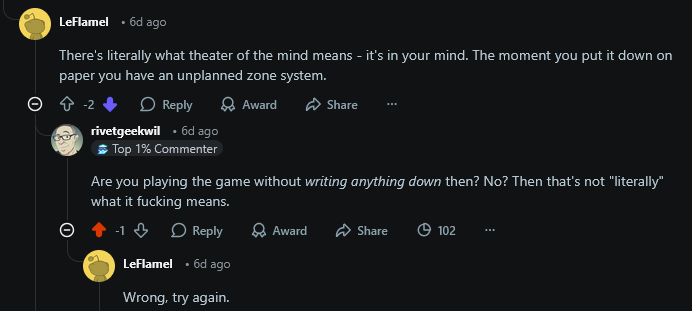
This is a term doing nothing useful. It’s a label whose entire job is to mark an absence, and which gets stricter and weirder the more seriously people take it.
It’s Not The Outlier
And that’s the thing that bugs me the most: “theater of the mind” is framed as the alternative. It’s thing you do instead of the normal thing. But if you zoom out across the history of the hobby and the breadth of games being played right now, while the elaborate-tactical-grid setup is definitely a thing (just look at how much effort VTTs put into battlemap functionality with dynamic lighting and fog of war), it’s not the default by any stretch.
Think about how many PbtA and FitD games, not to mention Fate, Cortex, and any number of games from the past 15-20 years expect you to play. None of them assume a battlemap, and few have action economies built around squares, grids, and zones of control. They’re built around fictional positioning. Going even further back, Vampire the Masquerade had no rules for minatures or battle maps. Call of Cthulhu has a MOV stat, but formal play on a map or grid has always been presented as an option, and not the default. The older editions of Traveller largely presented positioning as range bands using markers. Even with older versions of D&D (such as BECMI), we never used miniatures or battle maps, and I know of groups that ran whole campaigns without them.
Now, that isn’t to say that grids and hexes never existed. Using maps to help clarify play and give players an idea of where they are in relation to things is as old as the hobby. Plenty of older games such as GURPS and HERO are absolutely predicated on using some sort of grid. But compared to all of the other games, why does that style—the one with more specialized requirements—not have its own bespoke name? Why is it the unmarked default, while the other practice gets stuck with a borrowed phrase from radio drama that implies the players are sitting quietly imagining things?
I think we have it backwards.
What We Could Call the Other Thing Instead
If we’re going to give one of these styles a special name, it should be the one that has specific, additive features: a grid, measured movement, tokens or minis, line-of-sight rules, facing, zones of control, reach, etc. The thing that has the expansive dedicated vocabulary and requires dedicated equipment.
Some options I’d float, in no particular order:
- Tactical play. Honest, descriptive, and already in common use. The downside is that “tactical” gets used for any game with crunchy decision-making, including ones with no map at all, so it’s a little overloaded.
- Gridded play or grid-based play. Boring but extremely clear. You either have a grid or you don’t. It kind of leaves out non-gridded measured systems, but those are fairly rare in TTRPGs.
- Mapped combat. Narrower—specifically about the combat subsystem—but most of the disagreement is about combat anyway.
- Positional play. My current favorite, honestly. It points at what’s actually doing the work: precise spatial position matters mechanically, and the map exists to track it. Everything else flows from that.
- Wargame-adjacent play, if you want to be cheeky about the lineage. (I mean this affectionately. The lineage is real and it’s good.)
And what do we call the other thing, that’s currently mislabeled as “theater of the mind”? I’d argue we mostly don’t need a name for it, because it’s just playing the game. But if we need one, “narrative positioning” or “fiction-tracked positioning” both get at the actual mechanism: the group is keeping track of where things are in the shared fiction, and consulting that fiction when it matters, rather than offloading it to a coordinate system. “Conversational play” works too, and has the virtue of pointing back at the fundamental nature of the medium.
Any of these would be an improvement over a phrase that means “the imaginative private experience of a radio listener,” because that’s not what’s happening and it never was.
The Disclaimer at the End of the Post
None of this is an argument that you should stop using battlemaps, minis, or whatever VTT setup makes your Wednesday night game sing. If you love the tactical layer of pushing a token two squares to flank and it feels good to you and your table, then by all means, keep doing it (as if you needed my, or anyone’s, permission). There’s a reason that style of play has the following it does, and it’s not my place to begrudge anyone the fun they’re having with it.
What I’m pushing back on is the framing. The framing where the broader practice is defined as a lack, named after a different medium entirely, and treated as the thing that needs justifying. That’s backwards, and I think it quietly shapes how new players and new GMs think about what RPGs are “supposed” to look like.
Call it what you want at your own table. But if we’re going to coin terms for the hobby at large, let’s coin them for the things that actually need distinguishing, and let the default just be the default.
Whatever works for you, of course.
The line is consistently attributed to Steve Allen, but occasionally Orson Welles. I couldn’t track down the exact origin from one of his books, a broadcast, or an interview, but the attribution itself is widespread. ↩︎
Yes, I know, “RPGs are a conversation” is practically a PbtA bumper sticker at this point (along with “Play to find out”). But it’s a bumper sticker because it’s true, and because every time I try to find a better way to say it, I end up back at the same four words. ↩︎